
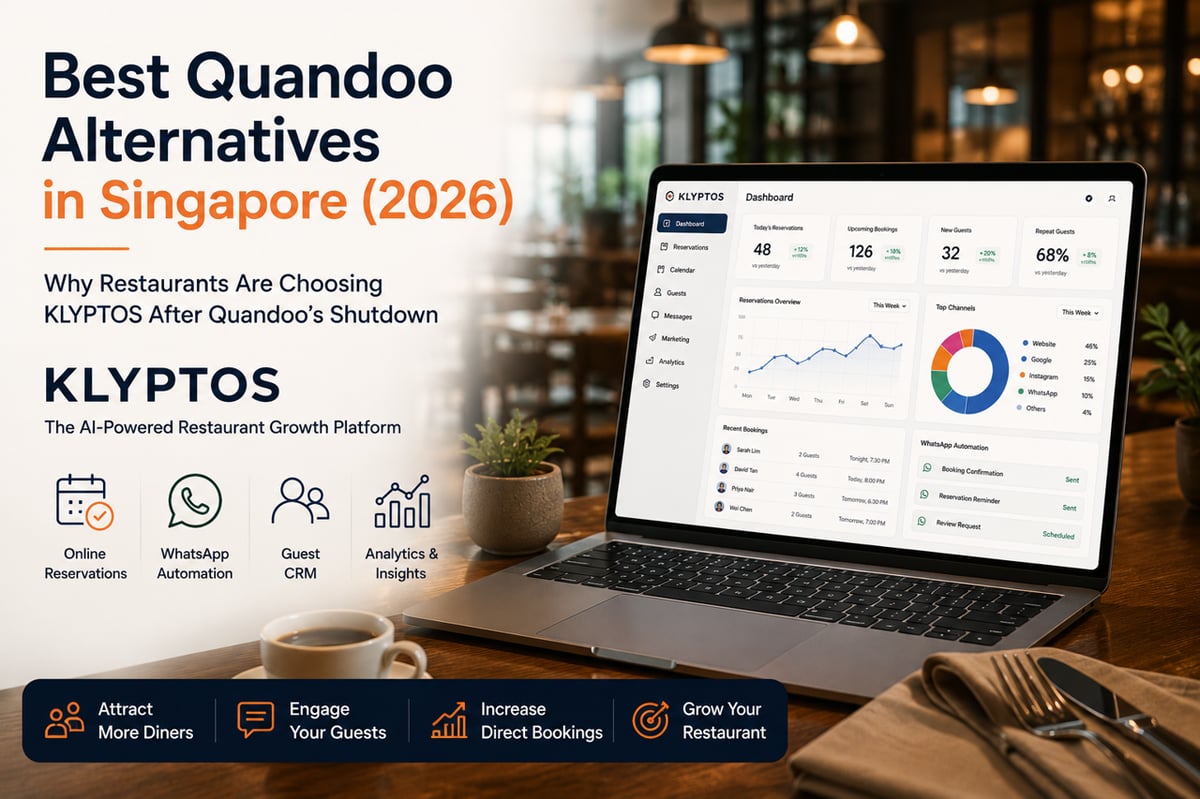
Restaurants comparing Quandoo alternatives in Singapore should look beyond the booking widget. A platform change can affect confirmed reservations, guest records, table settings, staff routines, reporting and customer communication.
The first priority is continuity. Existing and future bookings need to remain visible and manageable while the restaurant updates its website links, social profiles and internal processes. The second priority is choosing a platform that supports how the restaurant plans to operate after the migration.
Klyptos is one option for Singapore restaurants seeking a combination of restaurant discovery, online reservations, guest communication, customer management and analytics. Some capabilities are available today, while others remain planned or on the product roadmap.
What to look for in a Quandoo replacement
A replacement should first cover the operational basics. Restaurants need to confirm how existing bookings will be handled, whether future reservations can be imported, which booking channels are supported and how table, waitlist and cancellation workflows are configured.
Guest-data handling also matters. Operators should ask which customer fields can be transferred, whether visit history and preferences can be retained, and how permissions and communication records are managed. A technically possible migration may still require cleaning, mapping or manual review.
Staff usability is another practical consideration. Front-of-house teams need a clear view of bookings, guest notes, changes and no-shows during service. For restaurant groups, outlet-level permissions, central reporting and multi-location support should be checked before a decision is made.
Integration requirements should be reviewed separately from feature lists. Restaurants may need connections to websites, Google, social channels, WhatsApp, POS systems, printers or other third-party services. Operators should confirm which integrations are live in Singapore, which depend on external providers and which are still planned.
How Klyptos approaches restaurant reservations
Klyptos combines a consumer-facing restaurant discovery layer with tools for restaurants to manage their profiles and reservations. Current capabilities include restaurant discovery, online reservations, reservation management and restaurant profile management.
Available capabilities include WhatsApp automation, guest CRM, restaurant analytics and restaurant claiming. Together, these features are intended to connect booking activity with guest communication and operational visibility rather than treating each reservation as an isolated transaction.
Reservation, communication and guest-management capabilities
| Area | Traditional reservation-focused platform | Klyptos |
|---|---|---|
| Primary focus | Reservation capture and booking management | Restaurant discovery, reservations, guest communication, CRM and analytics |
| Restaurant discovery | Depends on the selected platform | Current |
| Online reservations | Commonly available; confirm supported channels | Current |
| Reservation management | Commonly available; confirm table and waitlist features | Current |
| Restaurant profile management | May vary by platform | Current |
| WhatsApp automation | Confirm with the provider | Available |
| Guest CRM | May vary by plan or platform | Available |
| Restaurant analytics | Reporting depth varies | Available |
| Loyalty and rewards | Depends on the selected platform | Roadmap |
| AI guest assistance | Confirm with the provider | Planned |
| Online ordering and printing workflows | Confirm with the provider | Planned |
Why WhatsApp matters in the workflow
Guest communication often continues after a reservation is made. Confirmations, reminders, enquiries and booking changes can create additional work when they are handled across separate channels.
Klyptos provides WhatsApp automation for reservation confirmations, reminders, customer enquiries, booking modifications, restaurant support, promotional communication and conversational ordering. Restaurants should still confirm the exact setup, message flows and third-party dependencies required for their operation.
Moving beyond a standalone booking tool
A guest CRM can give restaurant teams a more useful view of repeat customers by retaining visit history, preferences, special occasions, loyalty information and communication history. Analytics can then help operators review reservation trends, acquisition, occupancy, campaign performance and retention.
Klyptos also combines restaurant discovery with restaurant-side profile management. Restaurants can manage information such as menus, operating hours, photos, amenities, cuisine details, contact information, promotions and branding.
Several growth-oriented capabilities are not yet current features. Marketing and promotions, reviews and reputation management, an AI restaurant assistant, and online ordering and printing workflows are planned. Loyalty, rewards, personalised offers, gamification, memberships, post-visit engagement, win-back campaigns and customer lifetime-value analysis are on the high-priority roadmap.
Planning a reservation-system migration
- Review existing bookings. Separate completed, confirmed and future reservations, and identify any bookings that require manual attention.
- Confirm export options. Check which reservation and guest fields can be exported from the current platform and in what format.
- Review permissions and data quality. Remove duplicates where appropriate and confirm how customer information may be used after migration.
- Rebuild operating settings. Configure tables, service periods, booking rules, cancellation settings, guest notes and outlet permissions.
- Update booking channels. Replace links on the restaurant website, Google profile, social accounts and any campaign pages.
- Test the full journey. Make test bookings, changes and cancellations, then verify confirmations, reminders and internal notifications.
- Train the service team. Front-of-house staff should know where to find bookings, guest information and changes before the new system becomes the main operating tool.
- Monitor the first bookings. Where practical, run a controlled transition and watch for missing reservations, duplicate confirmations or incorrect availability.
Migration should not be treated as an instant switch unless the restaurant has confirmed that its bookings, data and workflows can be moved safely. Running both systems in parallel for a limited period may be appropriate, depending on the outgoing provider and the restaurant's operating needs.
Questions to ask before choosing a platform
- Can current and future reservations be imported?
- Which guest fields and visit records can be migrated?
- Which booking channels are supported in Singapore?
- How are WhatsApp messages, templates and replies handled?
- Does the platform support multiple outlets and central reporting?
- Which integrations are live today?
- Which features are planned rather than currently available?
- What onboarding and migration support is provided?
- How is restaurant and customer data handled?
Is Klyptos a suitable alternative?
Klyptos may suit Singapore restaurants that want more than a standalone reservation tool. Its current and available capabilities cover restaurant discovery, online reservations, reservation management, restaurant profiles, WhatsApp automation, guest CRM, analytics and restaurant claiming.
Restaurants that require loyalty, automated win-back campaigns, AI guest assistance, reputation management or ordering and printing workflows should note that these capabilities are planned or on the roadmap. Their availability should be confirmed before migration.
The right choice depends on the restaurant's booking volume, outlet structure, communication workflow, integration requirements and migration constraints. When reviewing Quandoo alternatives in Singapore, operators should protect existing bookings first, verify current functionality carefully and treat future roadmap features as a separate consideration.